
Movable Partition Track Installation Process: A Professional Guide from Basic Construction to Detailed Adjustment
I. Pre-Construction Preparation: Precise Measurement and Environmental Survey
Environmental Survey: Record the locations of roof beams, columns, air conditioning ducts, fire-fighting facilities, etc., to avoid conflicts between track installation and the building structure.Confirm the flatness of the ground; any error exceeding 5mm needs to be addressed in advance to prevent tilting after track installation.
Measurement and Positioning: Use a laser level to mark the track position lines on the ground, side walls, and ceiling, controlling the error within millimeters.
Mark the mounting holes for fasteners; adjust the spacing according to the track model.
II. Track Installation: Key Points for Different Types
Suspended Track (Ceiling Installation)Steps: Install expansion bolts into the floor slab at even intervals, and weld angle iron to form a steel structural frame.
Weld the track hangers to the steel structure, suspend the track using threaded rods, and adjust the levelness error to ≤1mm/m.
Lightweight tracks are fixed to the ceiling wooden frame with reinforced screws; heavy-duty tracks need to be welded to the steel frame.
Key points: A 20mm maintenance clearance must be allowed between the track and the ceiling; the pulley's load-bearing capacity must be greater than 1.5 times the partition's weight to increase load-bearing capacity.
III. Panel Installation: From Pulley Fixing to Overall Adjustment
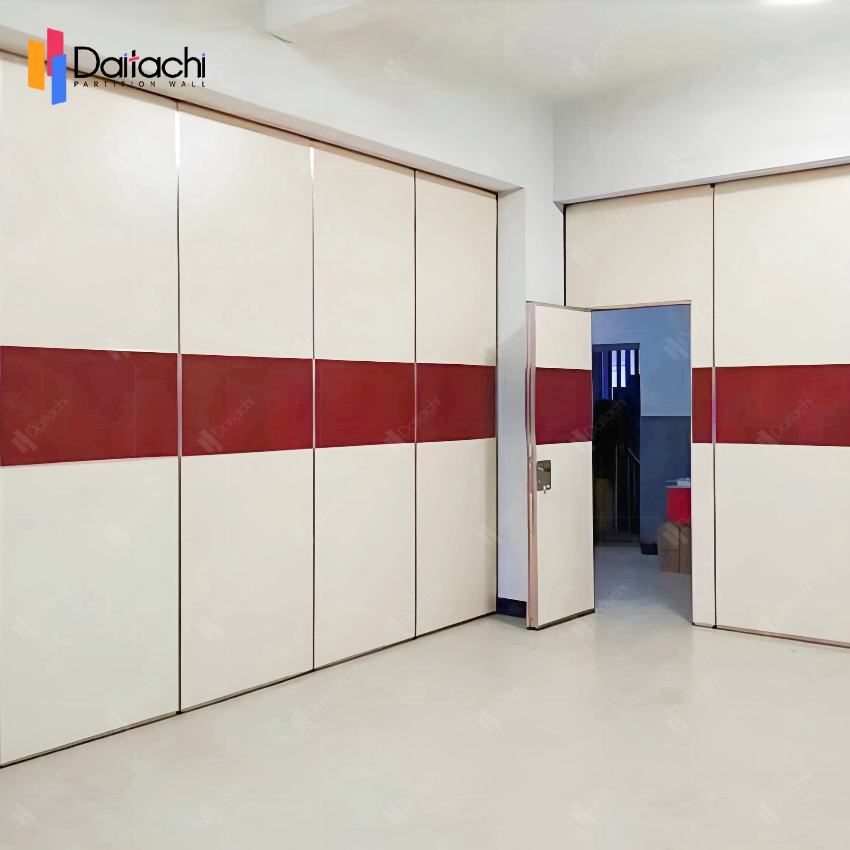
Pulley Installation: Mark the pulley center line on the panel and fix the pulley bracket with self-tapping screws, ensuring a 1-2mm gap between the pulley and the track.Accruised installation of pulleys on adjacent panels to avoid collisions during pushing and pulling.
Panel Assembly: Install each panel into the track, adjusting the verticality.
Connect the panels with concealed hinges; the hinge spacing is small, and the opening angle is adjustable from 90° to 180°.
Sealing and Edge Finishing: Embed high-density sealing strips at panel gaps, fix the top with aluminum alloy pressure strips, and install a brush at the bottom for dust prevention.
Use a 45° bevel joint at corners, with gaps ≤0.5mm.
IV. Commissioning and Acceptance: Ensuring Smooth Operation
Leveling Adjustment: Use a level to check the track. The error at the high edge should be ≤1mm/m. Correct by adjusting the lead screw or shims.Push-Pull Test: Apply a 50N force by a single person. The partition should slide smoothly without jamming or abnormal noise.
Verticality Acceptance: Use a plumb line to check the verticality of the panel. If the deviation exceeds 5mm, readjust the pulley height.
Sealing Test: Place an A4 sheet of paper between the gaps. The pulling resistance should be uniform.
Functional Test: The emergency escape track needs to be tested separately to ensure quick disassembly under 90kg pressure.
Sound Insulation Test: After closing the partition, the noise level should not exceed 35dB; the noise during panel assembly should be low.
V. Construction Standards and Precautions
Material Specifications: The track uses 6063-T5 aluminum alloy, reinforced with high-hardness aluminum alloy; the pulleys use double-reinforced nylon rollers.Fixed parts must be hot-dip galvanized, with a rust prevention grade ≥C4.
Common Problem Solutions
Track Deformation: Replace with high-strength track and add intermediate support points.
Pulley Jamming: Clean debris from the track and apply lubricant/grease.
Panel Misalignment: Adjust hinge tightness and recalibrate pulley positions.
Conclusion
The installation of movable partition tracks requires a balance between structural safety and operational accuracy. From initial measurement to final commissioning, every step must strictly adhere to specifications. Choosing a professional team for installation ensures a partition system lifespan of over 10 years while meeting core requirements such as fire resistance, sound insulation, and flexible partitioning.